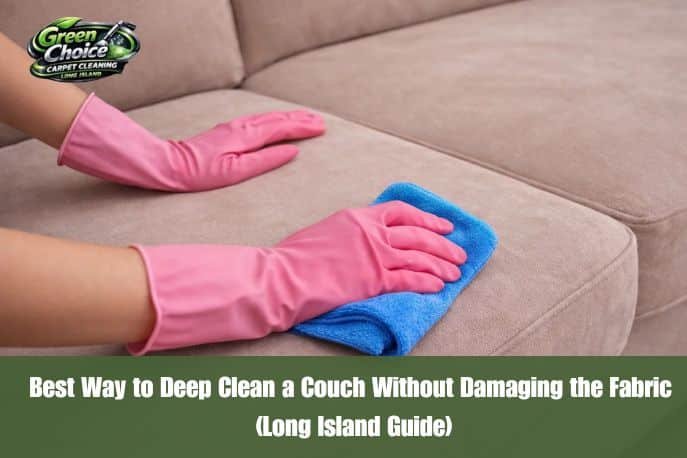
The safest way to deep clean a couch without damaging the fabric is hot water extraction by a professional but if you’re going the DIY route first, the key is knowing your fabric code, using the right cleaning method for that fabric, and never over-wetting the cushions. Get either of those wrong and you’re looking at shrinkage, water rings, mold in the padding, or permanent color damage.
We’ve seen all of it. Long Island homes come to us after a DIY attempt made things worse more often than you’d think. This guide tells you exactly how to do it right and where the line is between what you can handle yourself and when you need a professional.
Step One: Find Your Fabric Cleaning Code (This Is Non-Negotiable)
Before you touch your couch with any product or water, flip a cushion over and find the tag. Every piece of upholstered furniture has a cleaning code sewn into it. Using the wrong method for your fabric type is how damage happens.
| Cleaning Code | What It Means | Safe DIY Method |
|---|---|---|
| W | Water-based cleaning only | Mild soap + distilled water, damp cloth |
| S | Solvent-based cleaning only | Dry-cleaning solvent NO water |
| WS | Either water or solvent safe | Most flexible both methods work |
| X | Vacuum only no liquid | Brush and vacuum only call a pro for deep clean |
If your tag says S or X stop right there. Water will damage those fabrics. A lot of velvet, silk, and certain microfiber couches fall into this category. Don’t risk it.
The Right Deep Cleaning Method by Fabric Type
Once you know your code, the method depends on what your couch is actually made of.
| Fabric Type | Code | Best Cleaning Method | What to Avoid |
|---|---|---|---|
| Microfiber | W or S | Rubbing alcohol (for S) or distilled water spray | Tap water leaves rings |
| Cotton / Linen | W or WS | Mild dish soap + warm water | Hot water causes shrinkage |
| Velvet | S or WS | Low-moisture solvent method | Steam or soaking |
| Leather | W or WS | Leather cleaner + conditioner | Dish soap dries out leather |
| Wool blend | W | Cool water + wool-safe detergent | Hot water or aggressive scrubbing |
| Silk | S or X | Professional only | Any DIY attempt too risky |
| Synthetic blend | W or WS | Warm water + upholstery cleaner | Bleach-based products |
If you’re cleaning a leather furniture piece, it also needs conditioning after cleaning otherwise the leather dries out and starts cracking within months.
Step-by-Step: How to Deep Clean a Fabric Couch at Home
This works for W or WS coded fabric sofas in average condition no heavy staining, no pet accidents, no odor problems.
What you need:
- Vacuum with upholstery attachment
- Clean white microfiber cloths (not colored dye transfer is real)
- Distilled water (not tap tap water leaves mineral deposits)
- Mild dish soap or upholstery shampoo
- A soft-bristle brush
- A fan for drying
The process:
1. Vacuum first every inch Remove all cushions. Vacuum the base, the back, the sides, the cushion tops and bottoms, and every crevice. You’re removing loose debris before it turns into mud when moisture hits it. Don’t skip this step.
2. Pre-treat any visible stains Mix one teaspoon of dish soap into one cup of distilled water. Dab don’t rub onto stains with a white cloth. Work from the outside of the stain inward so you don’t spread it. Let it sit 5 minutes.
3. Clean the full surface Lightly dampen a cloth with your cleaning solution it should be damp, not wet. Wipe in the direction of the fabric grain. Work in sections. Replace your cloth when it gets dirty you’re not moving dirt from one area to another.
4. Rinse with clean water Use a second cloth with plain distilled water to wipe away any soap residue. Soap left in the fabric attracts more dirt faster.
5. Dry properly this is where most DIY jobs go wrong Don’t put cushions back until they’re fully dry. Stand them upright, point a fan at them, open windows if weather allows. Full drying takes 4–8 hours depending on humidity. Long Island summers are humid give it longer. Putting damp cushions back into sofa covers traps moisture in the foam and causes mold.
The Mistakes That Damage Couches
These are the things we see after DIY attempts that bring people to call us:
Over-wetting. The #1 cause of couch damage. Water soaks through the fabric into the foam padding. The outside dries but the inside stays wet for days. That’s where mold starts and by the time you smell it, it’s already through the foam.
Using the wrong product for the fabric code. Using water on an S-coded couch causes water rings and fabric distortion that usually can’t be reversed.
Scrubbing instead of dabbing. Rubbing a stain pushes it deeper and spreads it wider. Blot and dab, always.
Using colored cloths. Red cloth + damp fabric = red stain on your couch. Always use white.
Ignoring odor under the stain. If there’s a pet accident involved, cleaning the surface does nothing for the smell. The urine has soaked into the foam. It needs enzyme treatment to break down the odor compounds surface cleaning just masks it temporarily.
When DIY Isn’t Enough Honest Truth
DIY cleaning works fine for light maintenance and fresh spills. It doesn’t work well for:
| Situation | Why DIY Falls Short |
|---|---|
| Pet urine / odor | Needs enzyme treatment deep in the foam |
| Set-in stains (weeks or months old) | Bonded to fibers needs professional extraction |
| Heavy soiling across the whole couch | DIY can’t rinse deep enough |
| S or X fabric codes | Any liquid risks permanent damage |
| Silk, velvet, antique upholstery | Specialist handling required |
| After failed DIY attempt | Wrong method may have set the stain deeper |
If your couch falls into any of those categories, a professional clean isn’t a luxury it’s actually the cheaper option compared to replacing furniture you damaged trying to save money.
Our upholstery cleaning service uses professional hot water extraction equipment that cleans deep and extracts moisture properly so drying time is 2–4 hours, not 2 days.
What Professional Deep Cleaning Does That DIY Can’t
| What Gets Done | DIY | Professional |
|---|---|---|
| Surface dirt removal | ✅ | ✅ |
| Deep fiber cleaning | ❌ | ✅ |
| Foam/padding moisture control | ❌ | ✅ |
| Pet odor neutralization | ❌ | ✅ |
| Set-in stain treatment | Partial | ✅ |
| Allergen and dust mite removal | ❌ | ✅ |
| Fabric-safe method guaranteed | Risky | ✅ |
| Fast drying (2–4 hours) | ❌ | ✅ |
We also handle fabric upholstery cleaning, couch cleaning, and seat cushion cleaning as separate services so if just the cushions need attention, you don’t have to book a full job.
Quick Tip: Protect Your Couch After Cleaning
Once your couch is clean whether DIY or professional here’s how to keep it that way longer:
- Rotate cushions every few weeks so wear and soiling is even
- Address spills immediately blot, don’t rub, within the first 60 seconds
- Vacuum weekly with an upholstery attachment
- Keep pets off or use washable throws that you can throw in the machine
- Book a professional clean every 12 months or every 6 months if you have pets
Also worth knowing if you’re already having the couch done, it makes sense to book stain removal for any problem areas at the same time, and many of our Long Island customers combine it with residential carpet cleaning in the same visit.
We Serve All of Long Island
We come to your home across Nassau and Suffolk County no need to move anything or bring furniture anywhere.
Nassau County:
- Sofa Cleaning in Merrick
- Sofa Cleaning in Massapequa
- Sofa Cleaning in Hicksville
- Sofa Cleaning in Garden City
- Sofa Cleaning in Levittown
- Sofa Cleaning in Wantagh
- Sofa Cleaning in Syosset
- Sofa Cleaning in Plainview
Suffolk County:
- Sofa Cleaning in Huntington
- Sofa Cleaning in Babylon
- Sofa Cleaning in Bay Shore
- Sofa Cleaning in Commack
- Sofa Cleaning in Smithtown
- Sofa Cleaning in Islip
- Sofa Cleaning in Medford
- Sofa Cleaning in Lindenhurst
Bottom Line
Deep cleaning a couch without damage comes down to three things know your fabric code, use the right method, and never over-wet. Follow the steps in this guide for light DIY maintenance. But for set-in stains, pet odor, delicate fabrics, or anything you’re not 100% sure about call a professional before you risk damaging furniture that cost you real money.
We’re local, we’re based in Merrick, and we serve all of Long Island. One call gets you a straight quote with no surprises.
Call us at +1 (516)-894-2901 2275 Merrick Ave, Merrick, NY 11566
