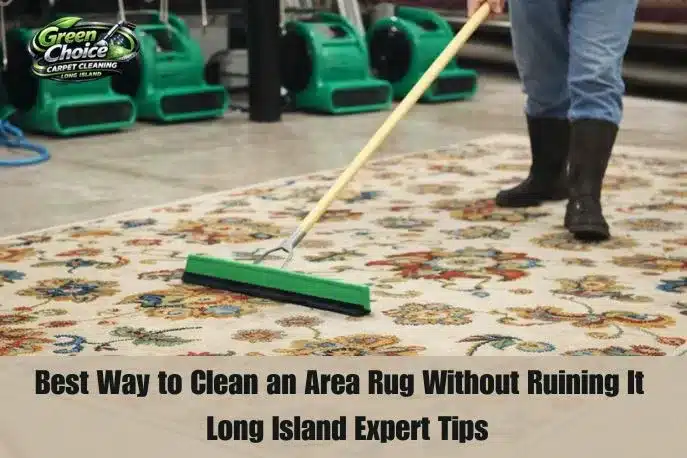
The safest way to clean an area rug without ruining it is to vacuum regularly, blot stains immediately, and have it professionally deep-cleaned once or twice a year. What most Long Island homeowners don’t realize is that the wrong cleaning method even something as simple as using the wrong solution or scrubbing too hard can permanently damage a rug that cost hundreds or even thousands of dollars.
I’ve seen it happen more times than I can count. A homeowner tries to save money by cleaning their wool or Persian rug themselves, and they end up with a rug that’s faded, shrunken, or has fibers that are completely matted down. At that point, no cleaner in the world can fully reverse it.
So let me walk you through exactly what works, what doesn’t, and what you should never do to your area rug.
This is the step most people skip, and it’s the most important one.
Every rug type has different fibers, different dye methods, and different tolerances for water, heat, and cleaning solutions. What works perfectly on a synthetic area rug can completely ruin a silk or wool rug.
If you’re not 100% sure what your rug is made of don’t experiment. Call us at +1 (516)-894-2901 and describe it. We’ll tell you exactly what it needs before you risk damaging it.
| Rug Type | Safe for Water? | Safe for DIY? | Best Cleaning Method |
|---|---|---|---|
| Synthetic (polyester, nylon) | Yes | Yes with care | Mild soap + cold water |
| Wool Rug | Limited | Risky | pH-balanced professional clean |
| Silk Rug | No | Never | Dry clean only professional |
| Persian Rug | Very limited | Never | Hand wash professional only |
| Oriental Rug | Very limited | Never | Low-moisture professional clean |
| Antique Rug | No | Never | Specialist professional only |
| Area Rug (general) | Depends on fiber | Partial | Vacuum + spot clean + annual professional |
For synthetic or basic area rugs, here’s the process that actually works without causing damage:
Most people only vacuum the top. Flip your rug over and vacuum the back side first. This loosens embedded dirt and pushes it toward the surface so your next pass on the front picks it all up. Do this once a week in high-traffic areas.
One important rule don’t vacuum the fringe. The vacuum roller will chew it up and cause fraying. Vacuum right up to the fringe and stop.
Old-fashioned, but it works. Hang your rug over a railing or fence and beat it with a broom handle. You’ll be shocked how much dirt falls out even after vacuuming. This is especially effective for thick pile rugs that trap a lot of debris deep in the fibers.
Before you apply anything to your rug even water test it in a hidden corner. Dampen a white cloth with your cleaning solution and press it firmly against the rug for 30 seconds. If color transfers to the cloth, stop immediately. That rug’s dyes are not stable and it needs professional cleaning only.
This is the biggest mistake homeowners make. When something spills, the instinct is to scrub. Scrubbing spreads the stain and drives it deeper into the fibers. Always blot press a clean white cloth firmly onto the stain and lift straight up. Work from the outside of the stain toward the center so you don’t spread it.
For fresh stains, plain cold water and blotting removes most of it. For tougher stains, a small amount of dish soap mixed with cold water works on synthetics. For pet stains specifically, you need an enzyme-based cleaner dish soap won’t break down the odor source. See our stain removal service if the stain has already set.
Soap residue left in rug fibers is a dirt magnet. Once you’ve treated a spot, go back over it with a cloth dampened in plain cold water to rinse out any cleaning product. Leftover residue makes that spot attract more dirt faster than the rest of the rug.
Never hang a wet area rug vertically the weight of the water pulls on the fibers unevenly and can distort the shape permanently. Lay it flat, preferably outside on a clean surface in the sun. Use a fan to speed up drying indoors. The goal is to get the rug completely dry within a few hours a damp rug sitting overnight is an invitation for mildew.
These are the mistakes we see constantly when homeowners call us to fix a rug they’ve accidentally damaged:
Never use hot water. Hot water causes natural fibers like wool to shrink. Always use cold or lukewarm water.
Never put a wool, silk, Persian, or Oriental rug in the washing machine. Even on a gentle cycle, the agitation and spin cycle can destroy hand-knotted fibers and cause irreversible damage.
Never use bleach or harsh chemical cleaners. These strip dye from natural fibers and can cause permanent discoloration. Even “color-safe” bleach is risky on anything other than synthetics.
Never scrub. We said it above but it’s worth repeating. Scrubbing unravels fibers especially in wool and hand-woven rugs.
Never let a stain sit. The longer a stain sets into the fibers, the harder it is to remove even professionally. Act within the first 15 minutes if possible.
Never use a steam cleaner on delicate rugs. Steam cleaners work well on residential wall-to-wall carpet but the heat and moisture combination can shrink, bleed, or distort delicate area rug fibers.
Here’s the honest answer: for anything other than a basic synthetic area rug, call a professional.
The cost of professional rug cleaning is almost always less than the cost of replacing a rug you’ve damaged. Here’s a quick guide on when you should stop and call us:
If you’re in Nassau or Suffolk County and any of these situations apply, call +1 (516)-894-2901. We’ll assess the rug and give you an honest answer on what it needs.
| Situation | DIY or Professional? |
|---|---|
| Light surface dirt on synthetic rug | DIY vacuum and spot clean is fine |
| Fresh small spill on any rug | Blot immediately, DIY if synthetic |
| Pet urine or odor on any rug | Professional enzyme treatment needed |
| Set-in stain on any rug | Professional |
| Any cleaning needed on wool rug | Professional |
| Any cleaning needed on Persian/Oriental/Silk rug | Professional only |
| Rug hasn’t been deep cleaned in 1+ year | Professional |
| Rug smells musty or has visible mildew | Professional immediately |
This depends on where the rug is and how much traffic it gets:
High-traffic areas (entryway, living room, hallway) vacuum twice a week, professional deep clean every 6–12 months.
Low-traffic areas (bedroom, guest room) vacuum once a week, professional deep clean every 12–18 months.
Homes with pets or kids vacuum more frequently and get professional cleaning every 6 months minimum. Pet dander, bacteria, and allergens build up in rug fibers faster than most people realize.
Antique, silk, or very valuable rugs professional cleaning every 2–3 years is usually sufficient, but spot treat immediately when anything spills.
Regular maintenance also protects your investment. A rug that’s professionally cleaned on schedule lasts significantly longer than one that only gets attention when it looks visibly dirty. By the time a rug looks dirty, it’s already had months of embedded grit slowly cutting at the fibers from the inside.
This deserves its own section because it’s the most common call we get from Long Island homeowners.
Pet urine is a two-part problem the visible stain and the invisible odor source. Most homeowners treat the stain and think the job is done, but the odor source (uric acid crystals) stays embedded in the fiber and backing. That’s why you clean it, think it’s gone, and then a week later when the humidity rises your whole room smells like pet urine again.
Here’s what actually works:
If the stain is old or the odor keeps returning after DIY treatment, it’s time for a professional. Our stain removal service uses professional-grade enzyme treatments that penetrate deeper than anything available at a retail store, and we also treat the rug backing where the urine has soaked through.
Of 123 Long Island rug jobs completed July 1 to October 8, 2026, 75 were steam cleaned on site, 48 were picked up for a plant wash, and 55 involved two or more rugs.
In the 100 days from July 1 to October 8 we finished 123 rug jobs across Nassau and Suffolk: 75 steam cleaned in the home with the truck-mounted machine, 48 rolled up, washed flat at our plant and delivered back. The technician decides at the door based on fiber, backing, urine, moth damage, and what the rug is worth relative to its size. Only one ticket in that period had the word wool on it; callers rarely know the fiber, so we test a few strands from the back edge on arrival and write the method and price down before anything gets wet.
Synthetic rugs, flatweaves and machine-made wool blends do well on site: the dyes hold and the rug is dry in a few hours. A rug goes to the plant when the latex back is crumbling, when it is hand-knotted and a wet test shows the dyes move, when a dog has been using it, or when it is too valuable to clean on a living-room floor. A plant wash also flushes out grit an on-site extraction leaves in the foundation, which is why a New Hyde Park customer who had an 8x10 done on site on an earlier visit chose pickup the next time and paid $300.
| On-site steam cleaning | Pickup and plant wash | |
|---|---|---|
| Jobs, Jul 1 to Oct 8 | 75 of 123 | 48 of 123 |
| Starting price | $99 first rug, $60 second rug | $150 per rug, free pickup and delivery |
| Time | About an hour, dry in 2 to 6 hours | 7 to 10 days door to door |
| Best for | Synthetic, flatweave, machine-made wool blends, normal soil | Hand-knotted, Persian and Oriental, urine-soaked, moth or water damaged, valuable rugs |
| Cannot do | Flush urine out of the foundation; fix dye bleed | Same-day turnaround |
The typical job that included a rug came to $350, with the middle half between $250 and $500; many of those tickets also had a sofa or carpeted rooms on them. Among the 85 rug-only jobs, the median was $300 and most people paid $250 to $450. The lowest was $100; the highest was $2,240, a Water Mill rug that had sat in water and needed a full restoration wash.
By price band: 4 jobs under $150, 39 between $150 and $299, 44 between $300 and $499, and 36 at $500 or more. The top band is mostly multi-rug households; 55 of the 123 jobs had two or more rugs. A Levittown customer had four rugs steamed on site and paid $255; a Malverne customer had three rugs plus a staircase for $200. Pickup jobs run higher because they start at $150 per rug and the rugs that go to the plant are bigger: a Babylon family once had one stained rug washed with a 90 percent stain-removal guarantee for $600.
The most rug jobs came from East Hampton (10), then Long Beach, Hewlett and Southampton (6 each), Freeport and Water Mill (5 each), Malverne and Wantagh (4 each). With Sag Harbor added, the East End was about a quarter of our rug work, despite being the longest drive from the Merrick office. Those calls usually mean several hand-knotted rugs at once, often with a sofa on the same ticket and no price set by phone because the owner wants the technician to see the pieces first; a Sag Harbor house had two sofas and three rugs done for $700. The South Shore Nassau towns are more often one or two synthetic or wool-blend rugs steamed on site at $99 and $60, booked with the price already set, often the same day.
Eight of the 123 rug jobs were pet accidents and one was moth damage. A fresh dog-vomit stain in Water Mill was handled on site for $300. When urine has reached the foundation, which shows as a yellow tide line on the back, the rug goes to the plant, because surface extraction cannot reach it and the smell returns with the first humid week. The moth case was a 6x10 in Lynbrook, picked up in July and washed for $450. Larvae eat from the back, so the owner sees loose pile before any moth. A plant wash kills whatever is living in the rug, and we say plainly which bare spots are permanent.
Every month someone calls after running a rented carpet machine over a wool rug. What we tell them: stop, do not add water, lay the rug flat with a fan on it, and do not hang it. The rental machine leaves most of the water in the rug, and wet wool shrinks unevenly, bleeds dye into the fringe and starts to smell from the back. A synthetic rug is usually fixed with an extraction on site for $99; wool or hand-knotted rugs come to the plant so the back dries under control.
On-site steam cleaning starts at $99 for the first rug and $60 for the second. Pickup and plant washing starts at $150 per rug with free pickup and delivery. Across the 85 rug-only jobs we did from July to early October, the median ticket was $300, usually for two or more rugs.
On site works for synthetic, flatweave and machine-made wool-blend rugs; 75 of our last 123 rug jobs were done this way and the rug is dry the same day. Hand-knotted Persian or Oriental rugs, and anything with urine in the backing, moth or water damage, go to the plant. The technician decides at the door.
Allow 7 to 10 days from the day we roll it up to the day we bring it back. Pickup and delivery are free across Nassau and Suffolk, from Long Beach to East Hampton. A Franklin Square customer who could not be home had the rug collected and approved the price by phone before we washed it.
Usually, but only with a full wash. Eight of our recent rug jobs were pet accidents. A fresh surface stain, like a Water Mill rug with dog vomit, can be handled on site for about $300. Once urine has soaked into the foundation, shown by a yellow line on the back, the rug needs a plant soak or the smell returns on the next humid day.
Stop adding water, lay the rug flat with a fan on it and call us the same day. Rental machines leave most of the water in the rug, and wet wool shrinks unevenly and bleeds dye into the fringe. A synthetic rug is usually corrected with an on-site extraction at $99; wool or hand-knotted rugs come to the plant to dry under control.
Whether you’re in a home in Merrick or a house in Huntington, we come to you. We clean all types of area rugs across:
Nassau County: Garden City · Great Neck · Rockville Centre · Syosset · Manhasset · Massapequa · Levittown · Valley Stream
Suffolk County: Huntington · Smithtown · Bay Shore · Commack · Babylon · Melville · Brentwood
Can I use baking soda on my area rug? Yes baking soda is safe for most rug types as a deodorizer. Sprinkle it on, let it sit for 30 minutes, then vacuum thoroughly. It won’t deep-clean the rug but it does absorb odors between professional cleanings. Don’t use it on silk rugs.
Can I pressure wash an area rug? Only for very basic outdoor or synthetic rugs, and even then be careful with pressure settings. Never pressure wash wool, Persian, Oriental, antique, or silk rugs the force will damage the fibers and backing.
My rug shrank after I washed it. Can it be fixed? Partial shrinkage from moisture can sometimes be addressed through professional stretching, but it depends on the fiber and how much shrinkage occurred. Call us and we’ll give you an honest assessment.
How much does professional area rug cleaning cost on Long Island? Most area rugs run $3–$8 per square foot. An 8×10 rug typically costs $100–$200 depending on fiber type and condition. Delicate or heavily soiled rugs may cost more. We always quote before we start. Check our full rug cleaning service page for more details.
Do you use eco-safe cleaning products? Yes. We use organic, non-toxic cleaning solutions that are safe for children and pets. Your rug is ready to use as soon as it’s dry.
If your area rug needs more than a vacuum and spot treatment or if you have a wool, Persian, Oriental, silk, or antique rug that needs proper care we’re here to help.
📍 Green Choice Carpet Cleaning Long Island 📌 2275 Merrick Ave, Merrick, NY 11566 📞 +1 (516)-894-2901 🌐 greenchoicecarpetcleaning-longisland.com
Call us today for a free quote. We’ll tell you exactly what your rug needs, what it’ll cost, and how fast we can get it done.
Same-day appointments across Nassau and Suffolk. Carpet from $25 per room (3-room minimum), $20 off any service when you book online, and a written price before we start.