If the pet urine smell came back a week after the carpet was cleaned, the urine was never removed; it was rinsed on the surface and left in the padding. That is the single most common complaint we hear from Long Island homeowners who had someone else clean first, and it is fixable. Here is why it happens, how to find every spot, and what actually gets it out for good.
When a dog or cat urinates on carpet, only a little stays in the fiber. Most goes through the backing into the padding and often onto the subfloor, where it dries into uric acid crystals. Those crystals are dormant when dry and reactivate with humidity, which on Long Island means every summer and every time someone cleans the carpet with water. A surface clean makes the room smell fine for a day and worse a week later. A deodorizer masks it for a month. Neither touches the padding.
You can smell one accident. You cannot smell four dried ones under the couch. We use a UV light in a darkened room; urine fluoresces, and the map is usually a surprise: the spot you called about plus three or four you did not know about, often along walls and under furniture. We also use a moisture meter, because a fresh accident reads wet below the surface even when the top feels dry. You get a photo of the map before we start, so the price covers every spot, not the one you saw.
All of it is part of our pet stain and odor removal service, and the same method works on sofas, mattresses and area rugs, where the urine is in the cushion foam or the rug foundation instead of the padding.
A typical job, one room with a few spots, runs $140 to $250 including the cleaning. That is less than the second and third surface cleanings people usually pay for before they call us.
| Job | Typical price |
|---|---|
| Enzyme treatment + sub-surface extraction, per spot | $30–$80 |
| Whole-room pet treatment (multiple spots) | $80–$150 per room |
| Carpet cleaning of the room | from $59 per room |
| Padding replacement, if needed | $1.50–$3 per sq ft |
| Subfloor sealing, if needed | $50–$100 per area |
Usually, yes: the yellowing is mostly the dried urine, and it lifts with it. Old, repeated accidents on light carpet can leave a faint discoloration where the urine bleached the dye, and no honest cleaner can reverse a dye change. We tell you which spots are which at the walk-through, before you decide.
Every town with a dog, which is every town. The busiest are the family neighborhoods: Levittown, East Meadow, Merrick, Wantagh and Massapequa in Nassau; Deer Park, Commack, Smithtown, Centereach and Coram in Suffolk. Humid waterfront towns like Bay Shore and Freeport are where the smell returns fastest after a bad cleaning.
Tell us how many pets, roughly how many accidents, and whether the carpet has been cleaned before. Call (516) 894-2901 or book online for $20 off. Same-day appointments across Nassau and Suffolk, and we bring the UV light on every pet call.
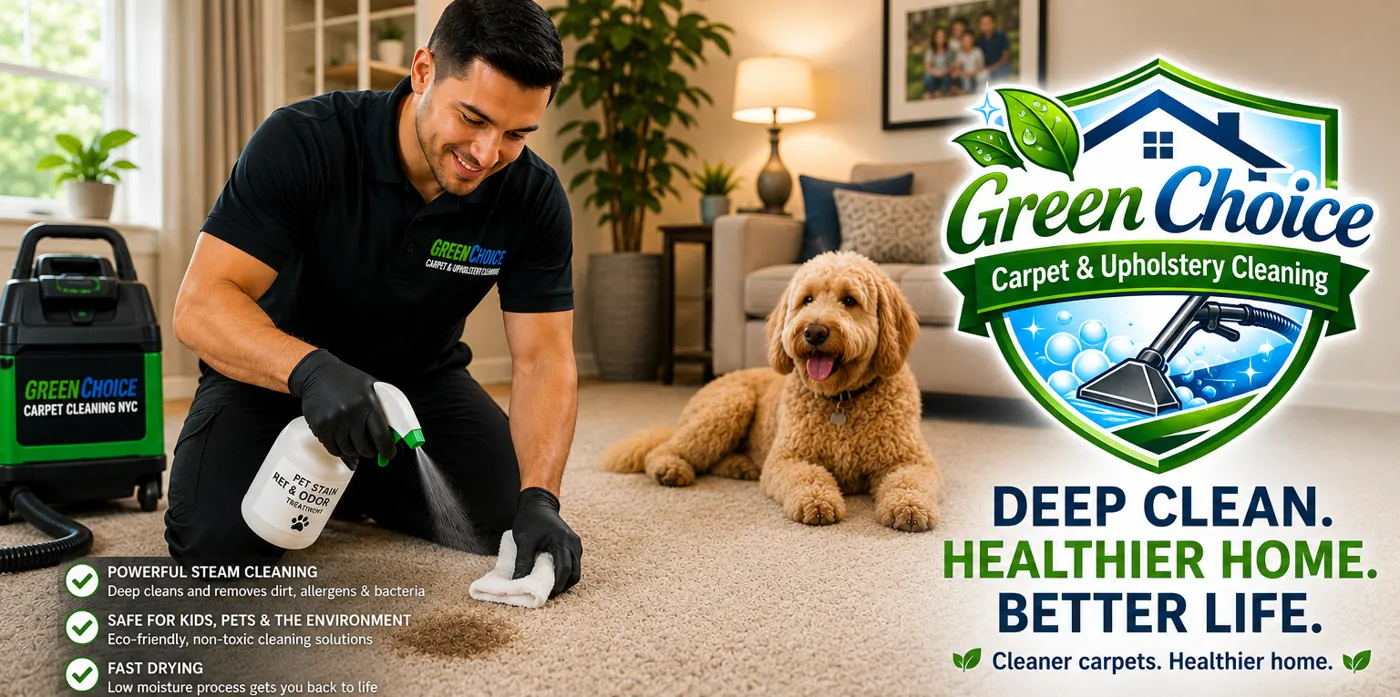
Because the urine is in the padding and subfloor, not the fiber. Surface cleaning rinses the top; humidity reactivates the dried uric acid underneath a few days later. Removal means treating and extracting the padding.
They work on the fiber if used with enough volume and time, but they almost never reach the padding, which is where most of the urine is. They are fine for a fresh accident caught immediately.
Usually. Cat urine is more concentrated and often reaches the subfloor, so it more often needs padding replacement and subfloor sealing. We find every spot with a UV light first and tell you what it will take.
$30 to $80 per spot or $80 to $150 for a whole room with multiple spots, plus the carpet cleaning from $59 per room. Padding replacement, when needed, is $1.50 to $3 per square foot.
Most of it lifts with the urine. Where an old accident has bleached the carpet dye, a faint mark can remain; we point those out before we start.
Same-day appointments across Nassau and Suffolk. Carpet from $59 per room, $20 off any service when you book online, and a written price before we start.